EN
EN
What is Aluminum Profile and How Does It Work?
2026/09/30
Source aluminum profiles for versatile modular framing. Learn extrusion mechanics, strength benefits & corrosion resistance. Request details.

2026/06/10
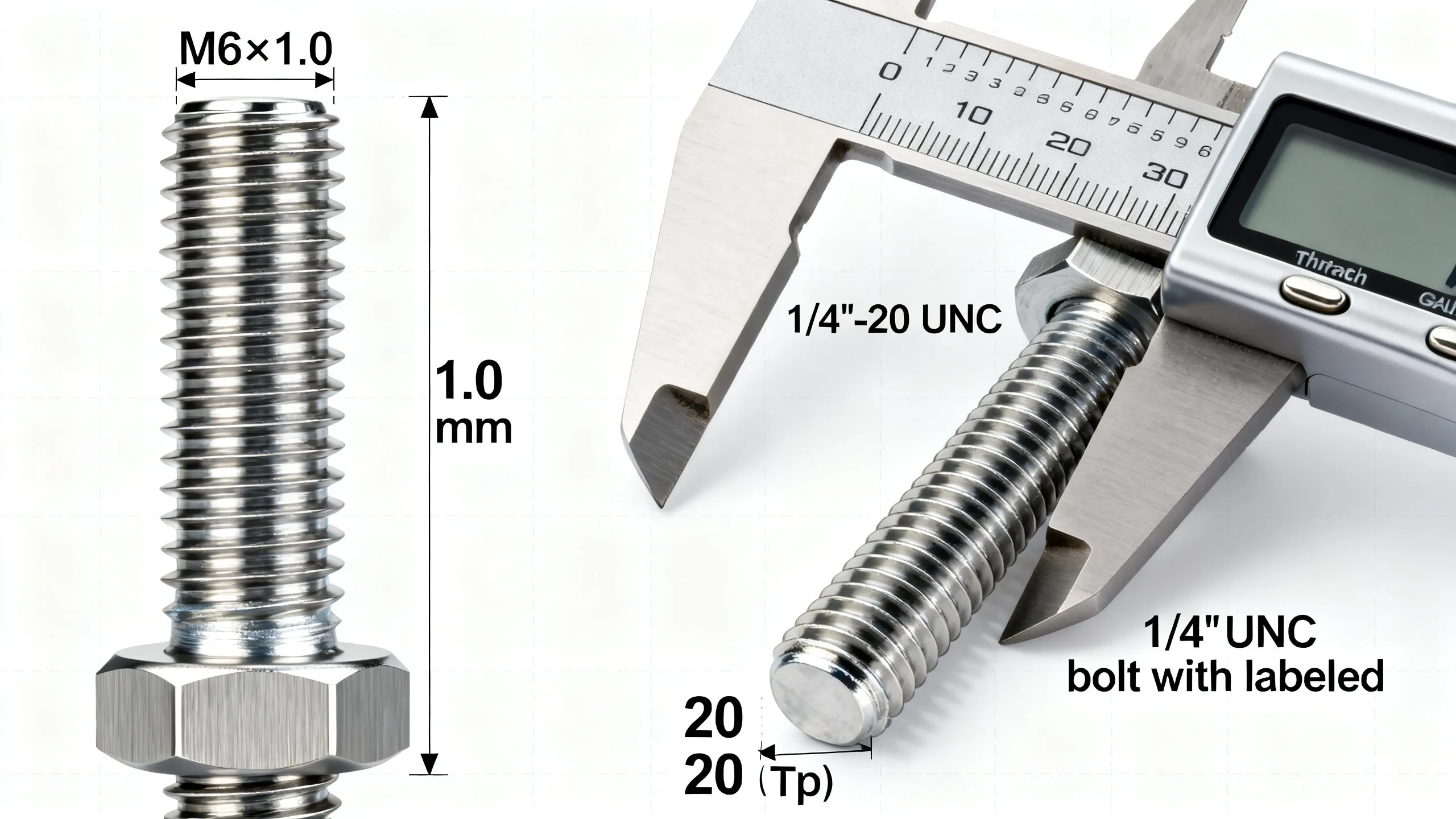
Thread pitch is one of the most fundamental yet frequently misunderstood concepts in fastener engineering—especially for procurement professionals, maintenance technicians, and product designers sourcing hardware globally. Whether you’re specifying bolts for automotive assembly, selecting screws for industrial machinery, or validating thread compatibility across international supply chains, understanding thread pitch ensures mechanical integrity, interchangeability, and compliance with regional standards. This guide demystifies thread pitch from first principles: how it’s defined, measured, and applied across major global systems—including ISO metric, Unified National Coarse (UNC), and Unified National Fine (UNF). We’ll clarify common misconceptions, illustrate practical measurement techniques, and highlight why consistent thread standardization matters in B2B procurement and OEM manufacturing.
Thread pitch refers to the axial distance between corresponding points on adjacent threads—typically measured in millimeters (mm) for metric fasteners or as threads per inch (TPI) for imperial units. Unlike thread diameter or length, pitch governs engagement depth, load distribution, and resistance to loosening under vibration or thermal cycling. A finer pitch (e.g., M10×1.25 vs. M10×1.5) increases tensile strength and thread shear area but requires more turns for full engagement. In high-precision applications—such as aerospace fixtures or medical device housings—even a 0.1 mm deviation can compromise clamping force or cause cross-threading. For global buyers, mismatched pitch is a leading cause of rejected shipments, rework delays, and costly field failures.
Accurate pitch measurement prevents specification errors during sourcing. Three reliable methods are widely used in quality assurance and warehouse inspection:
Always verify pitch on the functional thread (not the chamfer or uncut shank) and inspect at least three locations along the engaged length to detect taper or wear.
While thread pitch defines spacing, it operates within broader standard families—each with distinct thread angles, tolerances, and application conventions. The three dominant systems are:
Crucially, UNC and UNF share the same 60° thread angle and basic profile—but differ in pitch only. Confusing them during procurement can lead to incompatible mating parts, even when nominal diameters match.
For B2B purchasers and design engineers, thread pitch isn’t just a technical footnote—it’s a linchpin in supply chain reliability. When sourcing fasteners internationally, always specify both diameter and pitch explicitly (e.g., ‘M12×1.75, Grade 8.8, Zinc Flaked’), not just ‘M12 bolt’. Avoid ambiguous terms like ‘standard thread’ or ‘coarse thread’—these lack ISO or ASME definitions. Also note that thread class (e.g., 6g external / 6H internal) affects clearance and must be coordinated with pitch to ensure fit. Reputable suppliers provide full dimensional test reports—including pitch deviation per ISO 965-3—and maintain traceability to raw material heat lots. When evaluating vendors, ask for evidence of thread inspection capability—not just certification logos.
What is the difference between coarse and fine thread pitch?
Coarse thread pitch (e.g., M10×1.5) features wider spacing between threads, enabling faster assembly, greater stripping resistance, and better performance in soft materials like aluminum or cast iron. Fine thread pitch (e.g., M10×1.25) provides higher tensile strength, superior vibration resistance, and more precise adjustment capability—ideal for aerospace, automotive, and instrumentation applications where clamping accuracy is critical.
How do I convert TPI to metric thread pitch?
To convert threads per inch (TPI) to millimeters, divide 25.4 by the TPI value. For example, a 1/4"-20 UNC bolt has a pitch of 25.4 ÷ 20 = 1.27 mm. This conversion is essential when cross-referencing imperial fasteners against ISO metric specifications in global procurement workflows.
Can I use a metric bolt in an imperial threaded hole?
No—metric and imperial threads are not interchangeable, even when nominal diameters appear similar. For instance, an M6×1.0 bolt (6 mm diameter, 1.0 mm pitch) will not mate with a 1/4"-20 UNC nut (6.35 mm diameter, 1.27 mm pitch). Forcing mismatched threads causes cross-threading, joint failure, and potential safety hazards. Always verify both diameter and pitch before assembly.
Where can I find thread pitch conversion charts?
Reliable sources include ISO 261 standard tables, ASME B1.1 unified thread data, and manufacturer-published cross-reference guides. Professional procurement teams should maintain updated conversion charts covering ISO metric, UNC, UNF, BSP, and NPT thread families for accurate international sourcing.
Mastering thread pitch fundamentals empowers procurement teams, design engineers, and quality managers to make confident, specification-compliant decisions—reducing risk, minimizing returns, and accelerating time-to-installation. As global hardware supply chains grow more interconnected, clarity around fastener standards like thread pitch, tolerance class, and material grade becomes non-negotiable. Whether you're building machinery in Shenzhen, maintaining infrastructure in Berlin, or designing prototypes in Detroit, precise thread understanding bridges engineering intent with real-world performance. Explore our technical resource library for downloadable pitch conversion charts, ISO/ANSI cross-reference guides, and certified fastener selection tools—all designed for professional hardware buyers.
2026/09/30
Source aluminum profiles for versatile modular framing. Learn extrusion mechanics, strength benefits & corrosion resistance. Request details.
2026/09/30
Source aluminum profiles for construction projects. Learn structural framing, cladding & window benefits for maximum ROI. Download guide.
2026/09/30
Source optimal aluminum profile sizing techniques. Evaluate load, space, alloy, environment & cost factors to prevent deflection. Download guide.
2026/09/30
Struggling with fastener failures or rework? Master screw sizing by diameter, pitch, material, and load—plus industry-specific standards. Optimize reliability & compliance now.
2026/09/30
Source aluminum profiles for industrial engineering. Discover strength-to-weight ratios, corrosion resistance & 30% cost savings. Download guide.
2026/09/30
Source heat-resistant aluminum profile systems. Master thermal expansion science & stress management strategies for industrial builds. Download guide.